mandag 26. april 2010

Walking last Friday from the city center to School of Architecture, I found my self standing in the middle of the demonstration. I was witness to scene werepeople was running from tear-gas, police barracks in flames and sirens from the ambulance. I found out later that it was a demonstration against the politicians and their high-paid positions ..
Keep those inherited (public) spaces alive
Ovo je komad teksta iz Orisa o arhitektu Borisu Podrecca, koji rad idosta rehabilitacija javnig mjesta, izmedju ostalog i strosmayerov park u Splitu.


This is a part from text in a magazine, it´s about Boris Podrecca, a Slovene architect, working with restoration of the public space.


"At the time of the ”new economy”, with growing privatization and decreasing state investment in public space, city-planning is vanishing and the ideologists of the “generic city” are very well integrated into processes of maximizing profits.

Nevertheless, old European city-cores are still holding their own, even if for them means becoming less attractive for investors. Boris Podrecca’s intension in designing piazzas and promenades is “guerilla fight to somehow keep those inherited (public) spaces alive”.

Of course, this is not about historical reconstruction, but rather about the revitalization and rebuilding of often neglected and forgotten spaces. This revitalization is almost always linked to a tale about the history of a place, to particularities of the ambiance and architecture, where “looking” – visual perception – is an important criteria of feeling-well in the new space. The architect uses all the possibilities of rythmifisation, juxtaposition, and of tactile or even auditory sensation, because: “I cannot reduce myself to elegant Minimalist or tidy Protestant. I carry my multiplicity with me. It’s not easy to tame galloping horses.”

ORIS VI-27-04,


tirsdag 20. april 2010

Uncertain Encounters in Urban Space.
Because Uncertainty Creates Possibilities..


Hvordan endre en struktur?


*tanke: plassen

Hva er Skenderija? Hva er det som gir et området identitet? Hvordan fungerer det? Er det knyttet til fortid eller framtid? Tanker eller minner?


*notat

Skenderija er navnet til et senter i sentrum av Sarajevo. Senteret ble bygget i

1969. Det er et området som fungerer som knutepunkt for kultur som identitet i byen. Senteret kan også anses som viktig punkt for stedsutvikling for området rundt senteret. I dag går det an å se spor av fortiden som gjenspeiler seg i arkitekturen, noe som kan minne om at denne plassen var et viktig sosialt arena i byen.


*fakta:

Etter borgerkrigen i Bosnia mellom 1992-1995 ble politikken og økonomien

endret. Det førte til privatisering av eiendommer i sentrum. I dag eies 96% av

alle bygg i sentrum av private aktører. Dette fører også til at utbyggingen og

forbedringen av det offentlige rom blir redusert. Det er en økning i de private og

nedgange i de offentlige prosjekter. Parker, lekeplasser nye offentlige rom blir

nedprioritert til fordel for butikker, kafeer, casinoer, spillehaller og frisørsalonger...


tanke: konsept

Jeg ønsker å utforske identitetsspørsmålet rundt et historisk senter som

Skenderija, der jeg setter spørsmålstegn hvilket betydning har et området med

historisk kvalitet for byen og offentlig rom i dag? Er det eksisterende rommet og

programmet fungerende? I hvor stor grad kan et senter endre sitt program til å bli

til element som knytter sentrum. Er det tilsvarende rom i

byen? Jeg spør også hva som defineres som storplasser, åpne rom og i hvilken grad

er offentlige plasser brukt (Sarajevo sentrum)?

Seckond Confrontation: Placemaking


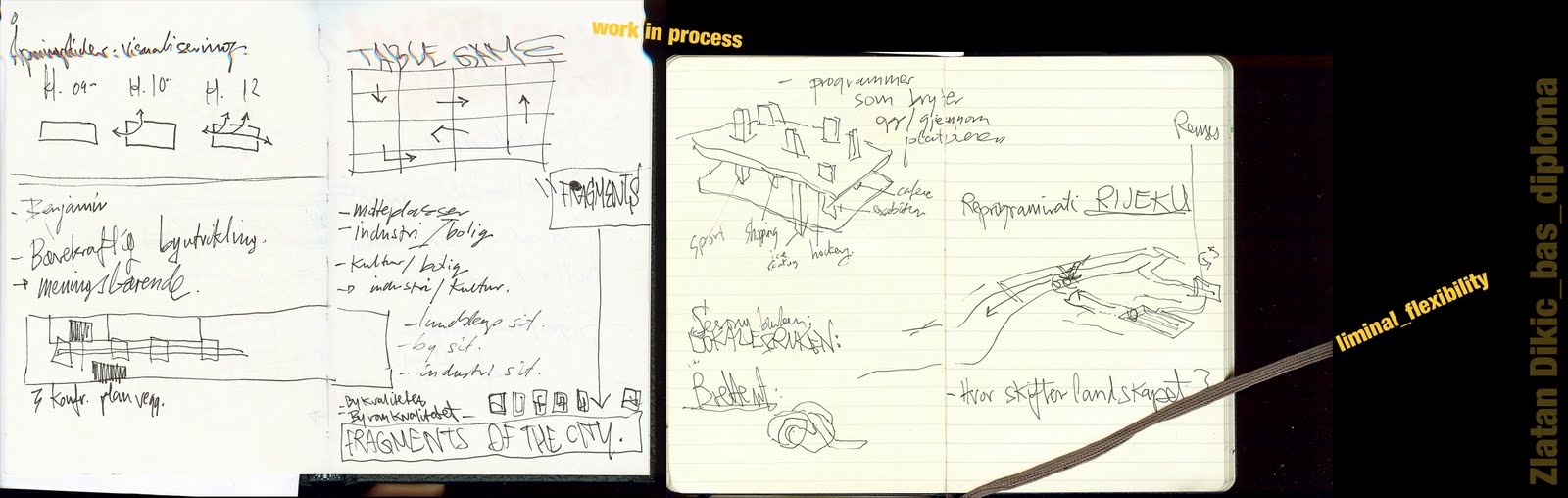
On our seckond confrontation we were working in groups. The theme in my group was PLACEMAKING. This was a great opportunity for students to work together and explain their work and project through drawing tasks.
Here are some key points for my project after working sessions with tutors Sverre Sondresen (APP) and Trudi Jaeger (DAV);

- urban space
- Uncertain encounters
- voids
- green spaces

mandag 19. april 2010

Scen Scenderija!

First day of research: After visiting today the School of Architecture in Sarajevo I came across this book about the area I am working with. The woman at the library helped me to scan the material (thanks)! Information and pictures in the book made me understand more about the area and the background of this historical site in Sarajevo. The text is only in Bosnian, but I will try to translate it soon...

Some key words:

- Modern Architecture
- Olympic Center
- New public space
- Cultural and sports center
- Trade center
- International recognition

Watch slides of old program from center Skenderija
View more presentations from Zlatan Dikic.

Sos ant zlatan dikic

fredag 26. mars 2010

First Models

Capturing some of my first thoughts, each model

(at the time) is functioning practice of its own.

torsdag 25. mars 2010

Pro Test Lab


Key words: urban space, new media arts, Eastern Europe, Lithuania, protest.


“This is my life and freedom is my profession,

This is my mission throughout all flight duration.

There is a core and it's hardcore,

All is hardcore when made with love.”

Gogol Bordello, “Undestructable”


This is a project that I was given as reference of my totor. Project Pro-Test Lab carrying some experiences like the area which I am working with. I ask questions like how can a place change its character (improve its identity)? What is it that define room and quality of the program? What is the scale condition?


Watch slide_Rethinking the use of space

View more presentations from Zlatan Dikic.

tirsdag 23. mars 2010

What is liminal?


Liminality in places

These can range from borders, to no man's lands and disputed territories, to crossroads to perhaps airports or hotels, which people pass through but do not live in. In mythology and religion or esoteric lore this can include such realms as Purgatory or Da'at which as well as signifying liminality some theologians have denied actually existing, making them, in some cases, doubly liminal. "Between-ness" defines these spaces. For a hotel worker (an insider) or a person passing by with disinterest (a total outsider), the hotel would have a very different connotation. To a traveller staying there, the hotel would function as a liminal zone (wikipedia).

Historical Building Period in Sarajevo


First Building Period


In the begining Turkish comanders lived very likely in the fort itself. Later, however, they transformed these objects to residential zones moving areas of the fort to new location next to river Miljacka, which is crossing through Sarajevo.

Seckond Building Period


In the year 1521 Gazi Husrev Bey was appointed to the office of the Sandjak Bay. He ruled the country with short breaks till the year 1541. Husrev Bey´s term mark

the beginning of the golden age of the architecture of old Sarajevo. First of all hi promoted the development of the business center in old town, where he build a group of various religious

buildings and so-called Bey´s mousque; furthure a huge bezistan (covered market), with 60 stores in business center. Husrev Bey´s examples was followed by other well-to-do

people, so that soon lively architectural activity set in. Mosque after Mosque was build high up in the old town of Sarajevo. The population streaming at that time

from the rural areas to the town, settled first in the neighbouring villages which belonged to the near by Mahalas (neigbourhood units) of the town. But as soon

new mosque was build in a village it became Mahala. The names of these Mahalas shows that they evolved from from villages.

Third Building Period


This last period of architectual activity begins with the death of Husrev Bey in 1541 and comes close in to the 16th century.

The residential area called ”Carsija”, had in the main been completed already before that time. Toward the close of the 16th century Sarajevo had about 50,000

innhabitants, 100 mosques, 2 churches, 1 synagogue, several public places, 3 high schools, 6 public baths, 3 markets, several store houses, numerous hotels,

about 1000 shops and 10 000 dwelling houses and gardens. The town water was supply from numerous near and far sources. When in the seckond half of the 16th

century Sarajevo ceased to be capital of Bosnia, it expanded no further. Yet the town remained, in spite of all viccisitudes, the most progressive town in Bosnia, a

fact which was due chifely to its favorable location.