mandag 21. juni 2010

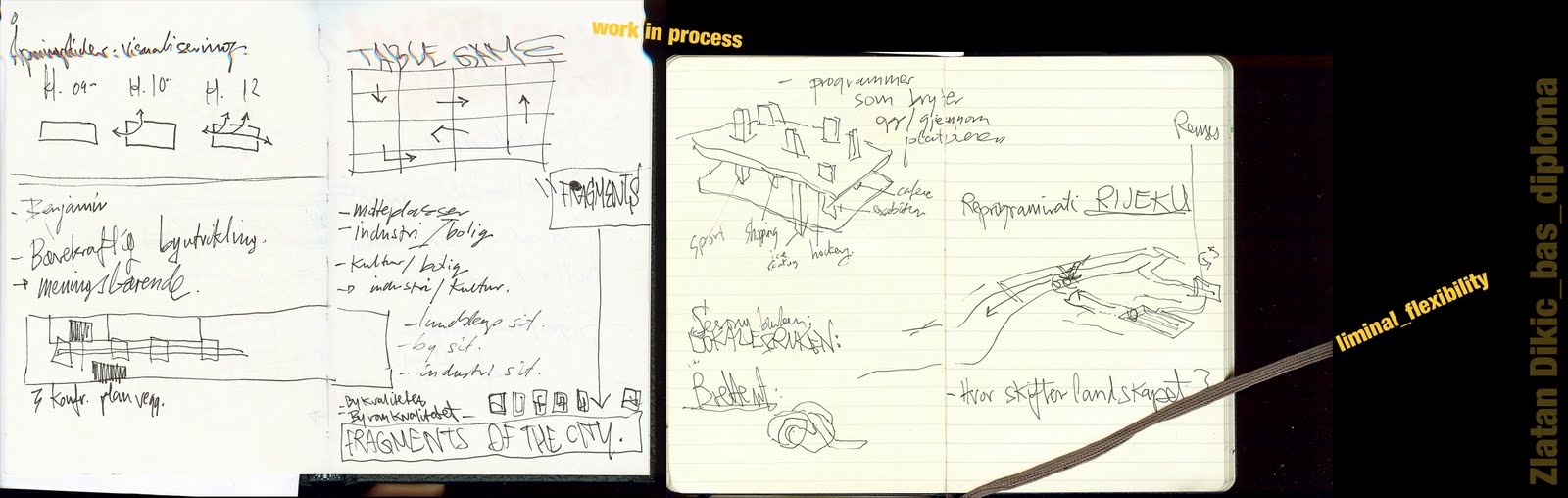
Game table is done


Finally, after third attempt to create a "game-table" that will help me understand the working situation better, I have now made a more logical plan how to make a register area of what are qualities and what can be changed. The first attempts were too complicated for me to work on them, because fields were divided more in a diagonal way, not following the structure or existing buildings. But this new method made me understand some analyses better, after all my site is mega-structure with potential to be transformed.
a_NOTE


The sketch above is to remember my self in which direction my diploma is going and what i am working on. Its easy to think that that you are will solve all the "challenges" at the site, but that seems to be utopic. After confrontation yesterday it was good to know that i am moving in the right direction. Some of the issues my diploma is dealing with is situations inside/outside of my center. What will generate more action inside? Whats good qualities inside? I have decided to keep two existing building as landmark in Sarajevo (services are culture and sport/basket), I would call it nostalgic architecture because it have symbolic value for the area and the city . Sal=hall 1 and sal 2 on the sketch are offering sports. Sal 1 is also exhibition space. How to use one hall for sport and other for new program? (Break up old structure) New parking space or vertical mix use space?

tirsdag 15. juni 2010

mutation_space


After the last confrontation its been happening at lot. I have started to break up the old structure and define the program (new sketches will be shown soon). I am looking at space with different levels and services. I have a feeling that center Skenderija is now looking like a mutation of different spaces and qualities. How can I show that and create new structure?

mandag 31. mai 2010

THIRD CONFRONTATION
l After last productive session in group-work on Friday, with tutors Arild Waage and Camilla Ryhl, my process is heading to a program. Here are some key notes which will provide the next step of choosing the final situations.


l


fredag 28. mai 2010

OPPORTUNITIES & TYPOLOGIES


The strong sens of history in the surroundings of Skenderija center is deeply rooted in styles and sensibilities of the eighteenth and nineteenth centuries. Since Sarajevo is under post war building and rebuilding, the sense of tradition is challenged by new and modern styles. Intention is to find approach where old characteristic are maintained, but supplemented by more current attributes. Looking towards the small spaces and voids where new situations can appear and town centers can adopt the village aesthetic along the MAHALA front enhance public utility. MAHALA fronts will also be developed more fully to encourage both private and public spaces.

MAKING A CONNECTION
Todays city situation is no longer a traditional single use of space. It´s a process happening on a global scale, were city is fading into multiple landscapes. New city spaces can be seen as urban paths and networks were city erupts in a heterogeneous land, a network of linked realities.

MAHALA (a way of connecting the realities)
Some aspects of Mahala:
- vertical space (only minaret on a mousque)
- local bakery
- lane with two rows of gates
The Mahaka is the street that leads from business part of the city to the residential area. The houses were arranged in zigzag patterns so that each of them commanded vista of the Mahala and the busines area.
Mahala = Neighbourhood Unit
As soon as 40/50 houses and a mousque were erected along the road, the settlement become a Mahala. History says that Sarajevo developed from 99 Mahalas and 99 Mosques.

VERTICAL SPACE


The models of investigation of the different layers, the movement between levels will be further investigation in the following steps.

tirsdag 25. mai 2010

Invasion of public space


It´s not only the new public spaces that I´am seeking for in my project. It´s about finding new way of showing the existing qualities. The pictures show projects done by Dutch artist, Hens Hofstra. His work is done in existing public space. The blue painted road features the phrase "Water is Life" written in eight-meter-high letters across it. The Blue Road is reminiscent of the waterway that used to be where the road is now. It's a memorial to nature, but it's also just plain awe-inspiring.
The sound is blasting


The great power of sound is blasting. The experiment of sound can be created to spread the music or the message...
See/hear the clip her...

What makes a biopolitical space?

"Hva er byrommets politiske dimensjon? Noe grunnleggende har skjedd i byen, noe forflyttet seg og organiserte seg i byen, man har sett det tydelig i forstedene, sier den italienske filosofen Antoni Negri i dette intervjuet med arkitektene og byøkologene Constantin Petcou og Doina Petrescu. Ifølge Negri begynner vi å se konturene av en ny generasjon som har oppdaget politikken utenfor partilokalene, og ser på byen som politikkens åsted."

This is article based on a interview with architects and city researches, Constantin Petcou and Doina Petrescu. It´s great reading material. It helped me put some thing in perspective. City is here, it´s time to take it.